

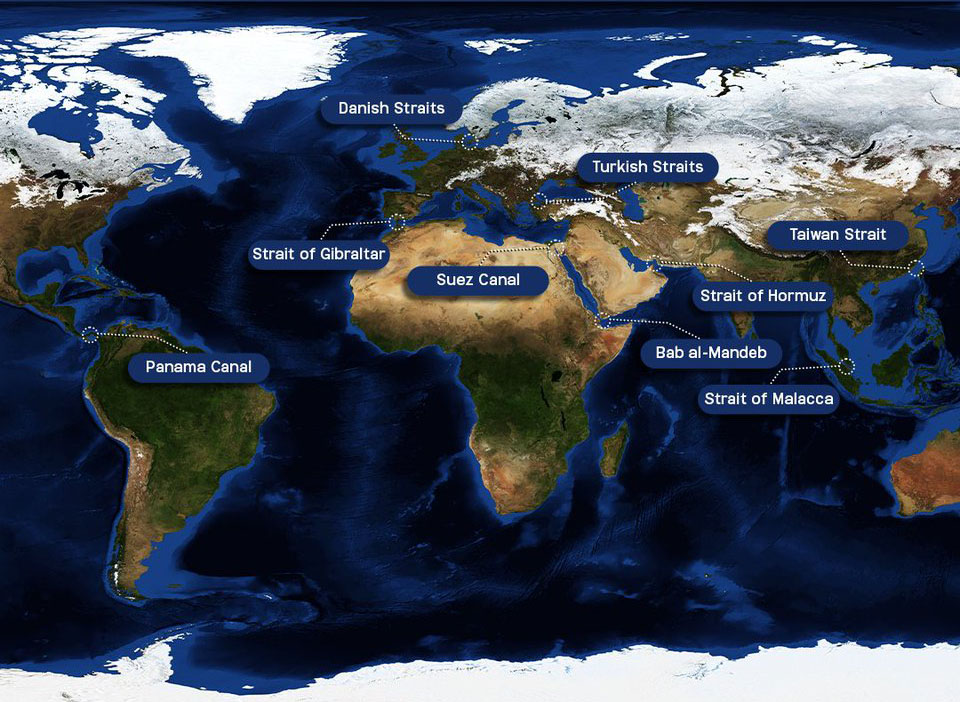
Energy Trade Through Strategic Chokepoints
Rethinking supply-chain resilience
JUNE 2026 | BLACK SWAN GLOBAL
A BSG Market Brief examining why physical routes—not only commodity availability—have become central to energy security, trading strategy and delivered-cost risk.
The View in One Minute
Energy security is often discussed in terms of reserves, production capacity and inventories. The events of 2026 have reinforced another reality: energy is only secure when it can move.
| THE CORE ISSUE
A globally adequate supply balance can still produce regional shortages and extreme delivered-cost volatility when a critical maritime corridor becomes constrained. |
| 20.9 mb/d | ~20% | 11.4 Bcf/d | 89% |
| Oil & petroleum liquids through Hormuz in 2025 | Share of global petroleum liquids consumption | LNG through Hormuz in 2025 | Share of Hormuz crude/condensate flows destined for Asia |
Why Chokepoints Matter
A maritime chokepoint is a narrow route through which unusually large volumes of trade must pass. Its importance is not defined by geography alone, but by the combination of volume, limited alternatives and the economic cost of rerouting.
The Strait of Hormuz is the clearest energy example. EIA estimates that 20.9 million barrels per day of oil and petroleum liquids moved through the strait in 2025, equivalent to roughly one-fifth of global petroleum liquids consumption. LNG flows averaged about 11.4 billion cubic feet per day, or more than 20% of global LNG trade.
Figure 1. Scale of energy flows through the Strait of Hormuz in 2025. Source: U.S. Energy Information Administration. Units differ by commodity and are shown on the axis.
Four Routes, One Global System
Hormuz is not an isolated vulnerability. The global energy system relies on a network of narrow passages whose disruption can change voyage distances, freight demand, insurance costs, vessel availability and regional price relationships.
Figure 2. Selected oil chokepoint flows using EIA 2025/first-half 2025 estimates: Strait of Malacca 23.2 mb/d; Hormuz 20.9 mb/d; Suez Canal/SUMED 4.9 mb/d; Bab el-Mandeb 4.2 mb/d.
| THE TRADING CONSEQUENCE
When a route becomes constrained, the market does not simply lose capacity. It reprices time, distance and optionality. |
The Asia Exposure
The geographic distribution of Hormuz flows makes the issue especially important for Asian energy security. EIA estimates that 89% of crude oil and condensate transiting Hormuz in 2025 was destined for Asian markets. China, India, Japan and South Korea were among the principal destinations.
Figure 3. Destination of crude oil and condensate flows through Hormuz in 2025. Source: U.S. Energy Information Administration.
This concentration creates a direct link between Middle Eastern maritime security and Asian refining, power generation, petrochemical activity and household energy supply.
A Disruption Travels Through the Value Chain
1 ROUTE
Transit capacity falls or risk rises.
2 SHIPPING
Voyages lengthen; vessel and insurance costs increase.
3 PHYSICAL MARKET
Buyers compete for alternative origins and prompt cargoes.
4 PRICING
Regional differentials, freight and replacement premiums adjust.
5 DOWNSTREAM
Refiners, utilities, industries and consumers absorb the impact.
Not Every Barrel Can Be Rerouted
The existence of an alternative route does not mean it is an economic substitute. Rerouting can add sailing days, consume additional bunker fuel, reduce effective vessel availability and create congestion at alternative terminals.
For some Gulf producers, pipelines provide partial bypass capacity around Hormuz. Saudi Arabia’s East-West pipeline and the United Arab Emirates’ Abu Dhabi Crude Oil Pipeline can move crude to export points outside the strait. But bypass capacity is limited relative to total flows and does not replicate the flexibility of normal maritime transit for every commodity.
LNG, LPG and refined-product chains face their own infrastructure constraints. Product specification, refrigeration or pressurisation requirements, terminal compatibility and vessel class can make substitution more complex than crude-oil rerouting.
The New Economics of Delivered Supply
| PRICE IS ONLY ONE COMPONENT
Delivered energy cost increasingly reflects commodity value + freight + time + financing + insurance + terminal costs + operational risk. |
This changes procurement analysis. A cargo that appears cheaper at origin may become less competitive after a route disruption increases voyage duration or freight. Conversely, a geographically closer supplier can gain strategic value even at a higher headline commodity price.
For traders and institutional buyers, route analysis should therefore sit alongside benchmark pricing. Freight curves, vessel positions, terminal constraints and geopolitical developments are increasingly part of the commercial decision rather than post-trade logistics.
Five Resilience Questions for Market Participants
- Where are our critical physical chokepoints – not only our suppliers?
- What alternative origins can be activated without changing receiving infrastructure?
- How much inventory buffer exists if voyage time increases materially?
- Which contracts provide practical flexibility in origin, vessel, loading window or discharge point?
- Do procurement decisions compare full delivered economics under disruption scenarios?
BSG Perspective
The events of 2026 reinforce a broader change in international energy trade. Competitive advantage increasingly depends on the ability to connect market intelligence with physical execution.
Supply diversification remains important, but it is only one layer of resilience. Effective commercial planning must also account for route concentration, shipping, storage, terminal access, financing and contractual flexibility.
The practical objective is not to eliminate disruption risk. It is to build enough optionality that a disruption does not become a commercial dead end.
Outlook
Strategic chokepoints will remain central to global energy trade because geography and infrastructure cannot be redesigned quickly. The market response is therefore likely to focus on redundancy: alternative supply origins, bypass infrastructure, larger strategic inventories, flexible contracts and improved real-time visibility of physical flows.
For energy-importing economies, especially in Asia, the question is moving beyond ‘Where does our energy come from?’ toward a more demanding question: ‘How many viable ways do we have to receive it?’
| BOTTOM LINE
Energy security is not only about having supply. It is about preserving the ability to move supply when the normal route is no longer normal. |
Sources & Data Notes
- S. Energy Information Administration (EIA), World Oil Transit Chokepoints / Strait of Hormuz analysis, 2026. Used for 2025 Hormuz oil and LNG flows, share of global consumption/trade, destination exposure and bypass-pipeline context.
- S. Energy Information Administration (EIA), international chokepoint estimates for the Strait of Malacca, Suez Canal/SUMED and Bab el-Mandeb, using 2025 or first-half 2025 flow estimates as reported by EIA.
- International Energy Agency (IEA), 2026 market commentary on disruptions to energy and LPG flows through the Strait of Hormuz. Used as contextual background on physical-market transmission and Asian exposure.
Publication Note
This publication is prepared by Black Swan Global – Market Intelligence & Insights as general market commentary. It is intended to support discussion of international energy-market developments and does not constitute investment, financial, legal, trading or other professional advice. Data are drawn from publicly available sources considered reliable at the time of publication. Market conditions can change rapidly.